4.Iris与集成学习
摘要
第四次机器学习课程实验
仅供参考
- 将数据集按7:3 的比例随机划分为训练集和验证集,随机数生成器种子为学号后三位数431,并输出训练集和验证集前10行数据;
1 | from sklearn.datasets import load_iris |
<font size=1>训练集前10行数据:
   sepal length (cm)  sepal width (cm)  petal length (cm)  petal width (cm)  \
0                4.7               3.2                1.6               0.2
1                6.5               3.0                5.5               1.8
2                4.9               3.1                1.5               0.1
3                5.6               3.0                4.5               1.5
4                5.0               3.4                1.5               0.2
5                5.8               2.6                4.0               1.2
6                4.9               2.4                3.3               1.0
7                4.6               3.2                1.4               0.2
8                5.7               2.6                3.5               1.0
9                5.4               3.9                1.3               0.4

   target
0       0
1       2
2       0
3       1
4       0
5       1
6       1
7       0
8       1
9       0

验证集前10行数据:
   sepal length (cm)  sepal width (cm)  petal length (cm)  petal width (cm)  \
0                5.4               3.7                1.5               0.2
1                6.7               3.3                5.7               2.5
2                5.0               2.0                3.5               1.0
3                5.1               3.5                1.4               0.3
4                4.4               3.0                1.3               0.2
5                4.7               3.2                1.3               0.2
6                6.4               2.9                4.3               1.3
7                4.4               3.2                1.3               0.2
8                5.7               3.0                4.2               1.2
9                5.1               3.3                1.7               0.5

   target
0       0
1       2
2       1
3       0
4       0
5       0
6       1
7       0
8       1
9       0
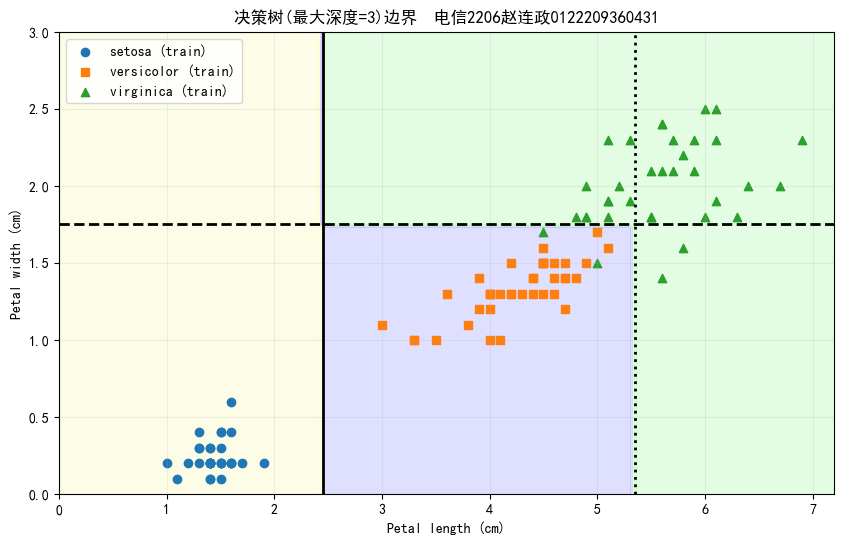
- 在训练集上训练决策树模型,生成如下的决策树边界
1 | from sklearn.tree import DecisionTreeClassifier |
- 在训练集上训练Bagging(基学习器自选)和随机森林模型,基学习器个数为100,输出决策边界图,并分析结果差异;
1 | from sklearn.ensemble import BaggingClassifier, RandomForestClassifier |
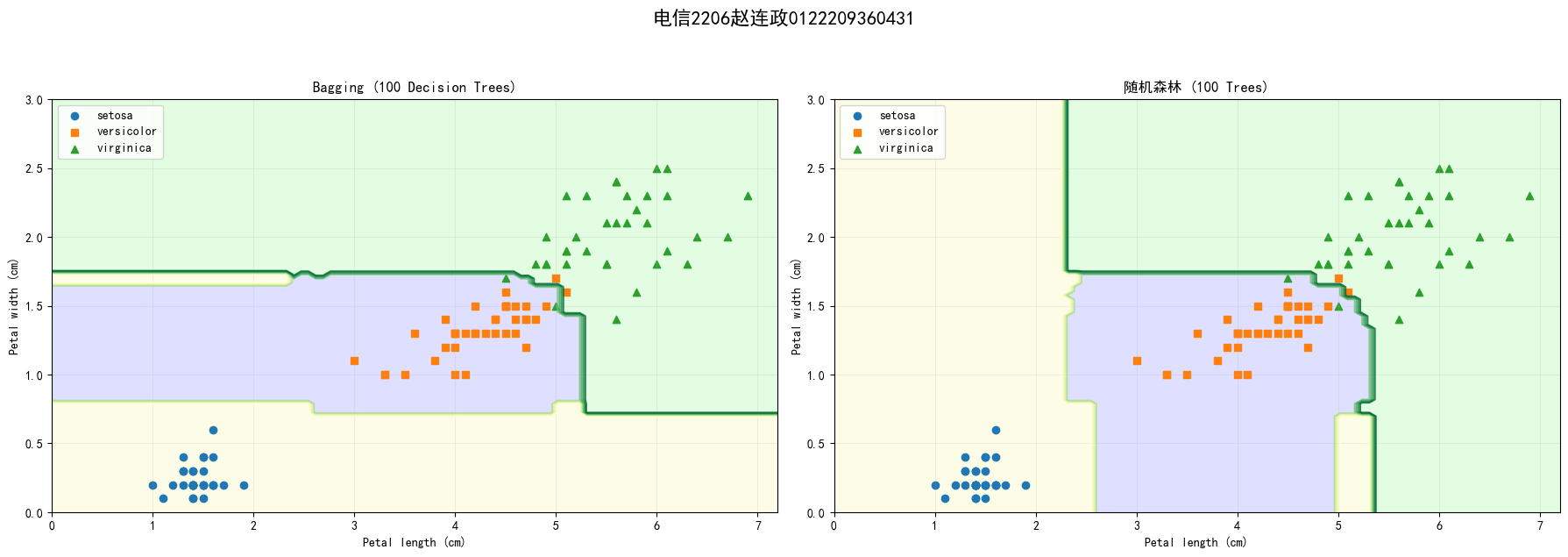
Bagging验证集准确率: 0.978
随机森林验证集准确率: 0.956
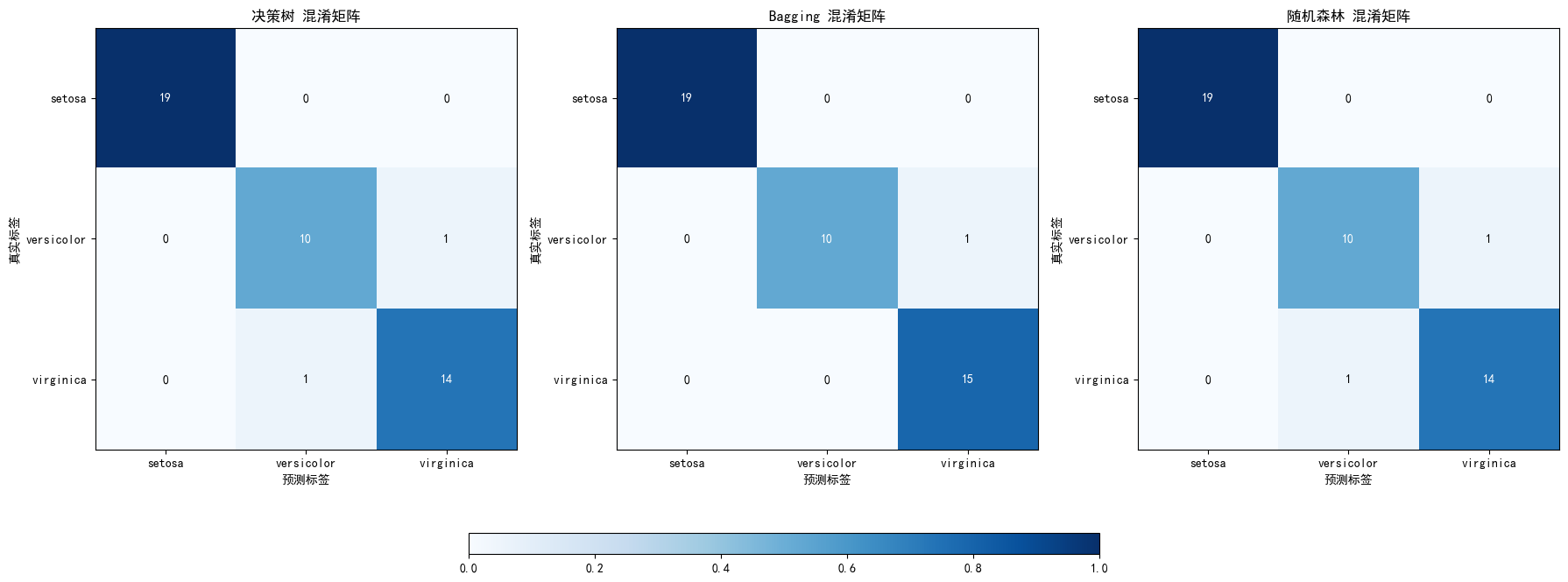
- 分别计算决策树、Bagging(基学习器自选)和随机森林模型在Iris数据集上三分类的混淆矩阵,并对三种算法的输出结果进行比较.
1 | # 计算混淆矩阵 |
决策树 混淆矩阵:
[[19  0  0]
 [ 0 10  1]
 [ 0  1 14]]
决策树 分类报告:
              precision    recall  f1-score   support

           0       1.00      1.00      1.00        19
           1       0.91      0.91      0.91        11
           2       0.93      0.93      0.93        15

    accuracy                           0.96        45
   macro avg       0.95      0.95      0.95        45
weighted avg       0.96      0.96      0.96        45

Bagging 混淆矩阵:
[[19  0  0]
 [ 0 10  1]
 [ 0  0 15]]
Bagging 分类报告:
              precision    recall  f1-score   support

           0       1.00      1.00      1.00        19
           1       1.00      0.91      0.95        11
           2       0.94      1.00      0.97        15

    accuracy                           0.98        45
   macro avg       0.98      0.97      0.97        45
weighted avg       0.98      0.98      0.98        45

随机森林 混淆矩阵:
[[19  0  0]
 [ 0 10  1]
 [ 0  1 14]]
随机森林 分类报告:
              precision    recall  f1-score   support

           0       1.00      1.00      1.00        19
           1       0.91      0.91      0.91        11
           2       0.93      0.93      0.93        15

    accuracy                           0.96        45
   macro avg       0.95      0.95      0.95        45
weighted avg       0.96      0.96      0.96        45


C:\Users\86182\AppData\Local\Temp\ipykernel_11464\1982013248.py:50: UserWarning: This figure includes Axes that are not compatible with tight_layout, so results might be incorrect.
  plt.tight_layout(rect=[0, 0.2, 1, 1])  # 调整布局以避免颜色条重叠